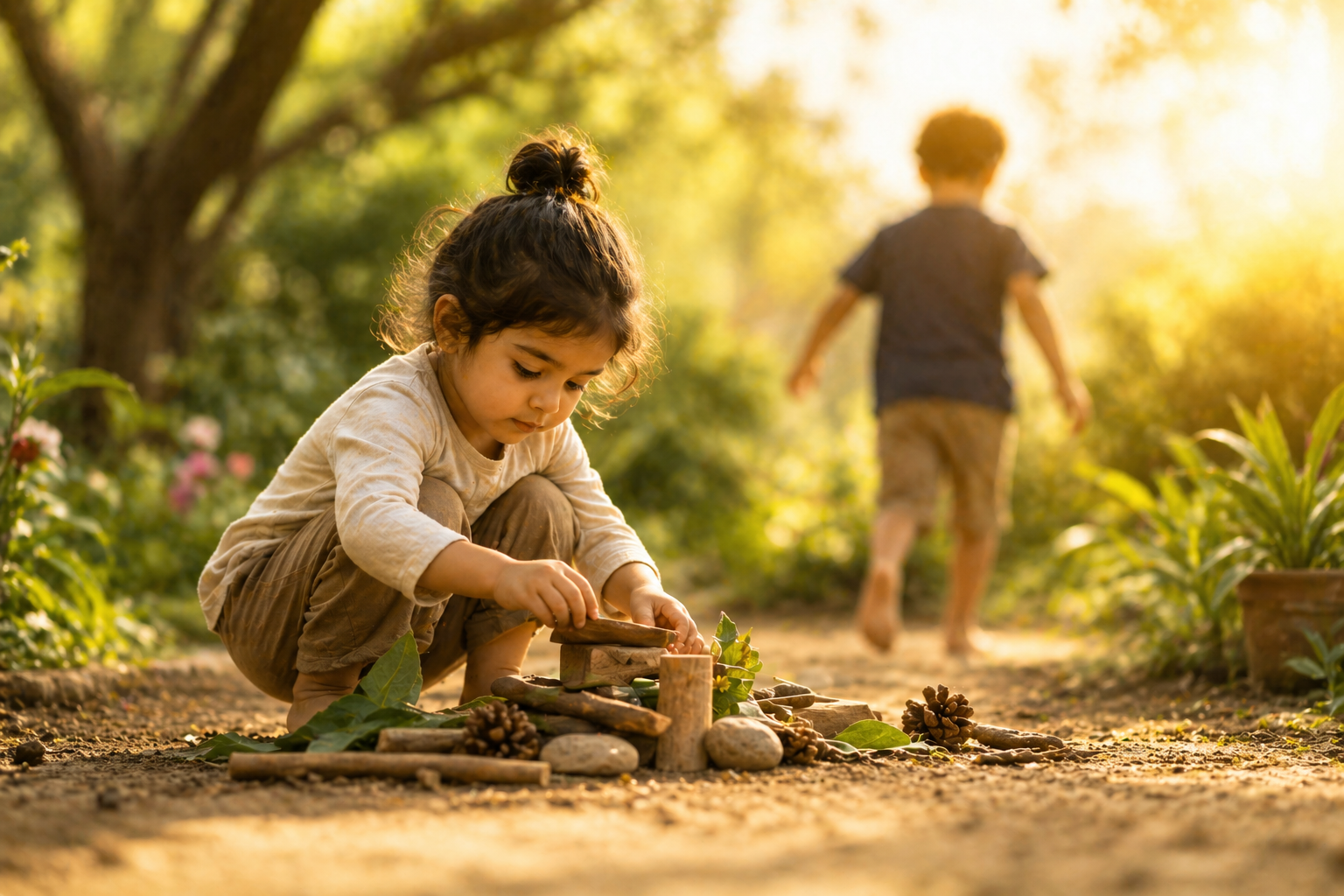
In today's education landscape, one of the most subtle but powerful pressures placed on children is the pressure to keep up.
To write earlier. To read sooner. To perform faster.
But childhood was never designed to be a competition.
The quickest way to make one line appear shorter is to draw a longer line beside it.
This is what comparison does in childhood development.
A child who is developing steadily and appropriately for their stage can suddenly appear "behind" simply because another child is moving faster in one visible skill. Development, however, is not a single track. It is multi-dimensional — emotional, physical, cognitive, and subtle. And most of these dimensions are not visible in a snapshot comparison.
Comparison distorts our view of the child in front of us, and this distortion results in loss of patience in the adult.
Across developmental science and echoed deeply in Vedic understanding, growth unfolds in stages. Each stage is foundational to the next.
Early childhood, in particular, is not a phase for acceleration. It is a phase for construction.
It is when the inner architecture of the child is being formed through the following:
When development is pushed for outcomes rather than readiness, we often unintentionally replace curiosity with anxiety, understanding with memorization, joy with performance, and inner confidence with external validation.
While the child may appear "advanced" in the short term, the deeper structure of learning becomes fragile.
The role of education is not to accelerate childhood but to honour its sequence.